

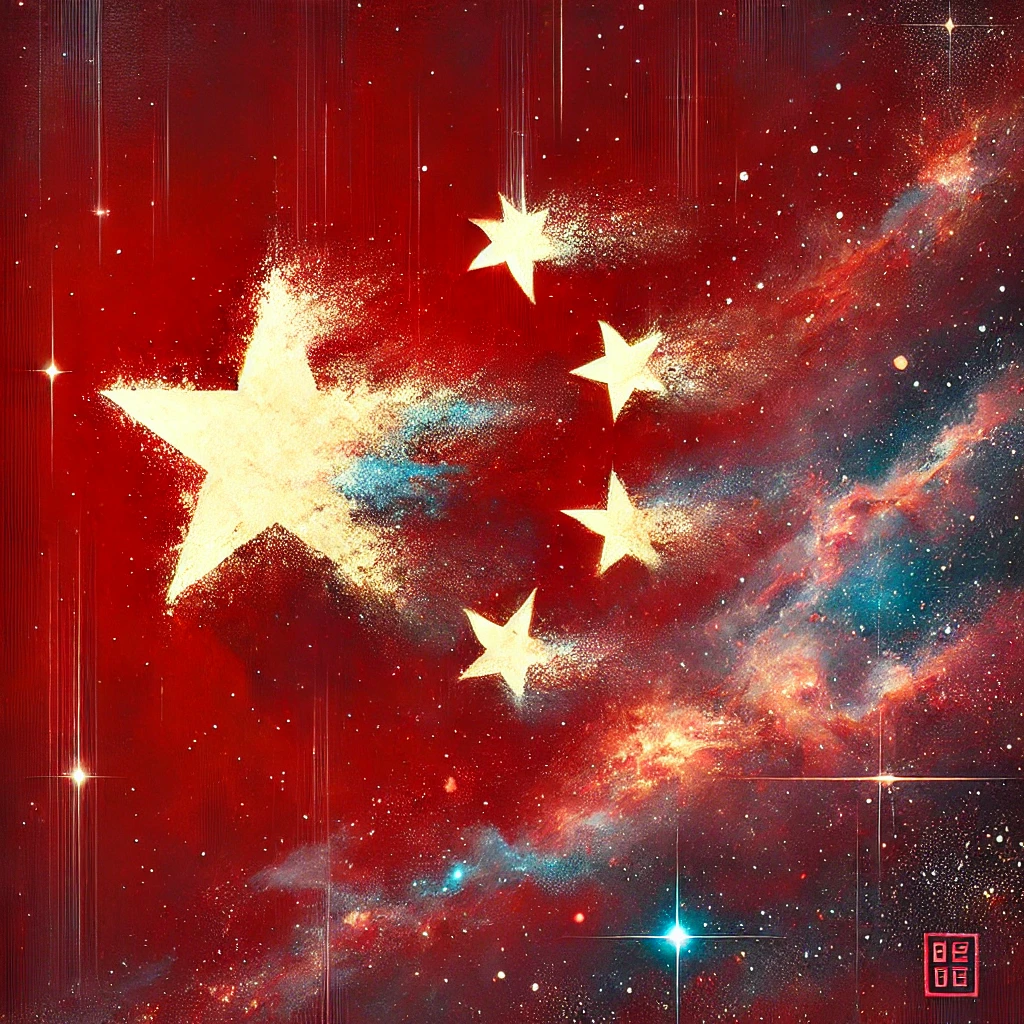
Death of a Star
China’s economy is confronting a serious trouble or rather a series of troubles. Not surprisingly, because it was doomed to be. China is drowning under an ‘excess problem’ which has many aspects:
• huge amount of excess manufacturing/production capacity,
• an excess of construction supply revealing itself as millions of unfinished and abandoned real estate projects and abundant number of empty/half-empty office buildings, and
• excessive indebtedness.
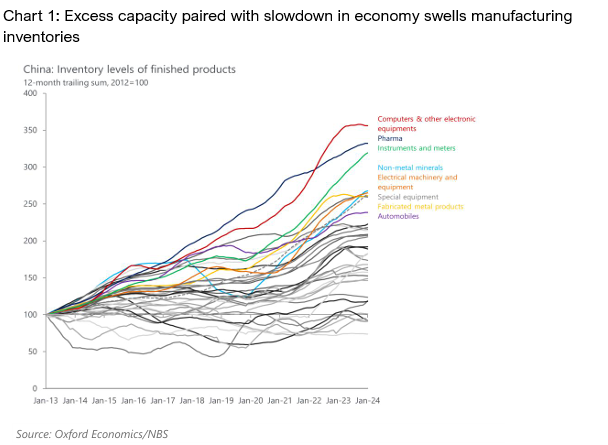
This excess situation, paired with weak domestic demand and lower margins (Chart 1), is not only causing problems at home but China also is exporting those troubles abroad.
The tragedy in the crisis of China’s economy is that it constitutes a stereotype example of Marxian explanation of the structural crisis of capitalism based on analysis of capitalist accumulation. Marx’s theory of accumulation is at the same time a theory of crisis and, the largest Marxist state could not comprehend this! Marx argues that the root cause of capitalist crisis is overproduction in the sense what can be profitably sold. “Overproduction, the credit system, etc., are means by which capitalist production seeks to break through its own barriers and to produce over and above its own limits… Hence crises arise, which simultaneously drive it onward and beyond [its own limits] and force it to put on seven-league boots, in order to reach a development of the productive forces which could only be achieved very slowly within its own limits.” (Karl Marx, Theories of Surplus Value, 1863)
In fact, there is a very similar pattern in nature that may help us to understand the collapse of Chinese economic model, once considered as a miracle. China has become an economic superpower and a major actor in shaping global economy within a period of only two decades following 1990. China is not only the world’s second largest economy representing 17 percent of global output, and the second largest trading nation with a trade volume exceeding the one of EU, but also China has accounted for a third of the cumulative increase in world GDP over the ten-year period until 2019. Additionally, she is the holder of largest foreign currency reserves with more than USD 3.3 trillion. So basically, China has risen as a star and become a giant. Just consider what happens to giant stars in the universe and I am sure this may seem strikingly alike!
Stars are sources of energy in a dark universe, thanks to thermonuclear reaction taking place in their depths. The enormous level of pressure and heat in the core of a star causes nuclei of atoms to crash into each other so hard that they stick together, or fuse. So, through the nuclear fusion reaction, lighter elements such as hydrogen and helium and heavier elements like carbon, oxygen or nitrogen are formed. All fusion processes below iron are exothermic, meaning they release energy in net terms. Throughout its life, a star maintains a balance between the force of energy flow emitting from its core and the force of gravity pulling its own mass inward. Once only iron remains in the core, the end is imminent. Without the outward pressure generated by fusion reactions to counteract the force of gravity, the outer layers of the star begin to collapse inward toward the core. Fate of giant stars has something very different, and very dramatic, the crushing weight of matter falling in from all sides compresses the dying star to a point of zero volume and infinite density, and a black hole is born. China seems to follow a similar path. The economic model which once was creating enough power to turn the wheel no longer suffices, because now it is too big. Subdued demand leads economic activity to decelerate, growth is falling, while insisting to keep overproduction causes deflationary pressures over an already hurt economy. When the model was working smoothly similar to earlier ages of a star, excess production flowing abroad was creating kind of centrifugal forces sustaining the balance, but as the economy slows down it becomes heavier, and those forces are not able to hold it. The risk of Chinese economy collapsing in on itself should not be neglected. If China turns into an economic black hole, there will be consequences.
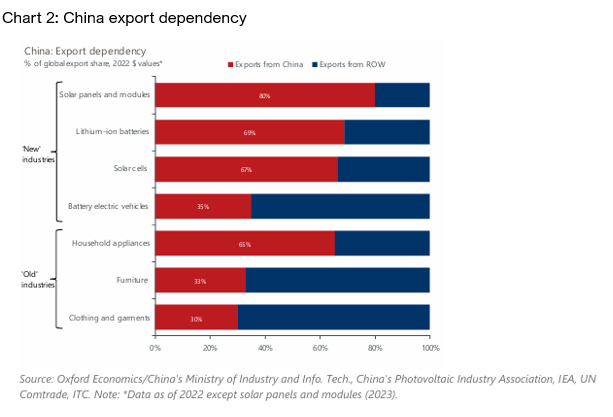
Chinese economic model is based on two cycles: one real and the other financial. Sociopolitical system suppresses domestic consumption causing compulsory saving and ultimately a saving glut, enabling excessive investment and exports. Average saving rate for the last 20 years has been more than 47 percent. During those brilliant years of China miracle, the weight of investment in China’s GDP has always remained above 40 percent, whereas private consumption has a share of 37 percent. This first cycle required residents to refrain from consume, income to be invested and the outcome to be exported abroad (Chart 2). The second cycle was meant to make this continue: the government which has almost total and absolute control over the economy has been reinvesting the revenue generated by the first cycle back in the assets of export markets. And hence China was holding an extensive amount of US bonds.
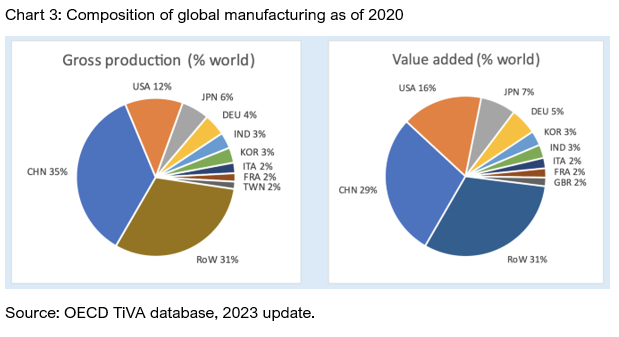
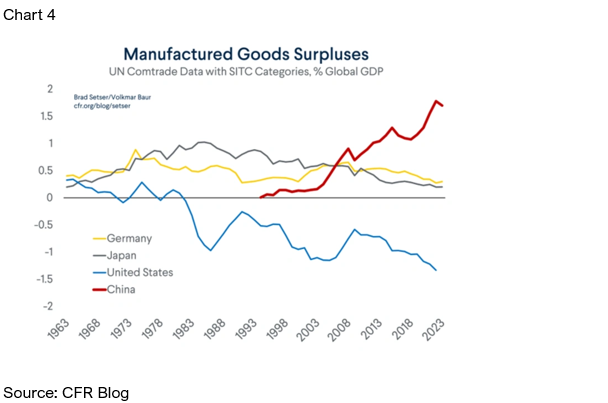
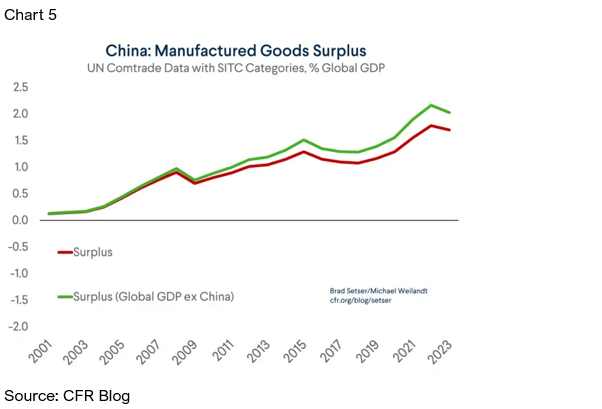
The smooth functioning of this model is possible only if global economic integration is maintained, economic activity occurs by means of global supply networks, and value added is created and distributed through global value chains. And for almost two decades it has worked well, so that China was representing a third of global manufacture production on its own (Chart 3). However, after 2016, and especially in the aftermath of the global Covid pandemic, it seems the global economic system has been in demise. Protectionism is on the rise, production is desired to be local or at least more regional, and capital to be repatriated. China’s excess capacity, which is no longer confined to specific sectors as was the case in the past but is widespread and increasing, is considered a serious problem by several nations, with the US being the leading one (Chart 4 and 5).
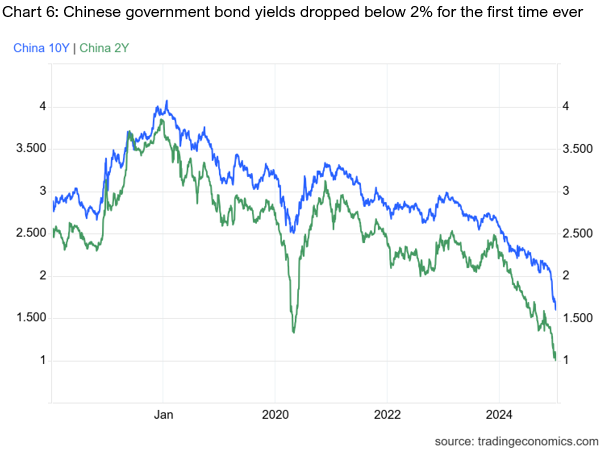
Measures the government in China has taken so far are heading in the wrong direction and naturally aiming at the wrong target. Expansionary measures focus on troubled producers and offer further support to sustain an unsustainable business model. This, first, deteriorates the financial burden of the problem and increases the risk of contagion on other segments of the economy because toxic assets are poisoning China’s financial system. Moreover, such subsidy-based measures put more pressure over other countries, while they are already complaining about the economic crisis in China spilling over onto the rest of the world. What is worst, subsidies pull resources away from other areas where they may be more productive to sectors where there is already an excess capacity, and hence cause further decline in productivity by distorting optimal allocation of economic resources. One may think that stimulating domestic private demand for goods and facility consumption is a more sustainable solution but revitalising domestic market to absorb excess capacity definitely takes time. In addition, it requires the whole system to be redesigned, while China is facing some structural problems stemming from income distribution, consumer culture, demographics and political governance; certainly rendering such efforts to be futile. Since last October, China’s National Development and Reform Commission has launched a series of stimulus packages but after initial positive moves, these could not prevent markets to continue to fall. Bond market is already pricing deflation, if not recession. Amid deteriorated consumer confidence and bearish market sentiment (Chart 6), measures are very unlikely to boost consumption and, there is a clear and imminent danger for China’s economy: falling in a vicious cycle where demand and supply issues will mean lower employment and wage growth lead to a further fall in private consumption. Narrowing margins and increase in the number of loss-making corporates are clear exhibits for the problem. National Bureau of Statistics of China data suggests profits earned by China’s industrial firms dropped by 4.7% year on year to CNY 6,7 trillion in the first 11 months of 2024, steeper than a 4.3% fall in the prior period, highlighting an economic weakness due to persistently weak demand, deflation risks, and a property downturn. This is not a temporary, one-off problem; non-finance companies listed in mainland China had recorded a combined net profit of CNY 2.85 trillion the year before, according to DZH data. Capital efficiency has been stagnant among Chinese companies, with the return on equity declining 0.7 point to 7.7%. This puts China behind Japan and the U.S., where ROEs sit above 9% and 18%, respectively.
So, to put it simply, China’s economy has been destined to end up with today’s situation, from the day the miracle started. This problem is always embedded in it. A black hole once formed swallows all available matter around in China’s case what is left in terms of economic and financial resources. The main concern for many analysts is the deterioration of the geopolitical and economic outlook, due to risks posed by the tension between the new US administration and China can cause. China is too big to fail, and if she ultimately does, she will not be alone.
References
Baldwin; Richard; 2024. China is the world’s sole manufacturing superpower: A line sketch of the rise, VOXEU Column, CEPR, 17 Jan 2024.
China is the world’s sole manufacturing superpower: A line sketch of the rise | CEPR
Al-Haschimi, Alexander; Emter, Lorenz; Gunnella,Vanessa; Martínez,Iván Ordoñez; Schuler, Tobias; and Spital, Tajda;. 2024. Why competition with China is getting tougher than ever, The ECB Blog, European Central Bank. 3 September 2024
Why competition with China is getting tougher than ever
Lawder, David, 2024. Yellen wants G7 ‘wall of opposition’ to China’s excess industrial capacity, REUTERS. May 23, 2024.
Yellen wants G7 ‘wall of opposition’ to China’s excess industrial capacity | Reuters
Lubin, David, 2024. China’s economic policy pendulum has swung towards stimulus – but keep expectations low, Chatham House. 14 October 2024.
Liu, Zongyuan Zoe, 2024. “China’s Real Economic Crisis: Why Beijing Won’t Give Up on a Failing Model”, Foreign Affairs, September/October 2024.
https://www.marxists.org/archive/marx/works/1863/theories-surplus-value/
The National Development and Reform Commission (NDRC) of People’s Republic of China
National Development and Reform Commission (NDRC) People’s Republic of China
Trading Economics
TRADING ECONOMICS | 20 million INDICATORS FROM 196 COUNTRIES
Turhan, Ibrahim M. (2023): The Second ‘New World Order’. Unpublished Working Paper.
Weilandt, Michael, and Baur, Volkmar; 2024. “China’s Record Manufacturing Surplus”, from Follow the Money and Greenberg Center for Geoeconomic Studies; Postt by Brad W. Setser, March 10, 2024.
China’s Record Manufacturing Surplus | Council on Foreign Relations
World Bank Open Data

Leave a Reply